Skip to main contentA smart wallet in Incentiv is more than a place to store cryptographic keys — it is a programmable account that acts as the user’s trusted interface to the blockchain. Powered by Advanced Account Abstraction (AAA), smart wallets form the core of how users authenticate actions, enforce personal security rules, and interact with applications across the network.
Traditional EOAs depend entirely on a single private key and offer no room for customization. Incentiv replaces this model with native smart contract wallets, giving every user an account that can define its own behavior rather than inheriting fixed protocol constraints.
What Makes a Wallet “Smart”
A smart wallet contains built-in logic that determines how actions are approved and how the account behaves. Instead of relying on one key for every decision, the wallet can incorporate flexible authorization methods, contextual safety policies, and tailored access rules. It becomes a durable identity layer shaped around how people naturally manage trust and security, not around the rigid limitations of legacy account design.
Incentiv treats this capability as the default, giving users an account that adapts to them rather than requiring them to adapt to the blockchain.
How AAA Enables Smart Wallets
Legacy blockchains expect every action to originate from an EOA signature. This design limits what wallets can do. AAA removes that barrier by redefining how the protocol receives and processes user actions.
In Incentiv, each interaction begins as a UserOperation — a structured request expressing what the user wants to do. The smart wallet evaluates the request according to its own rules. If the operation is valid, the wallet authorizes it and the network executes it. If not, it never reaches the chain.
This architecture makes the wallet the decision-maker and the protocol the executor. The user defines the rules; the network ensures they are enforced.
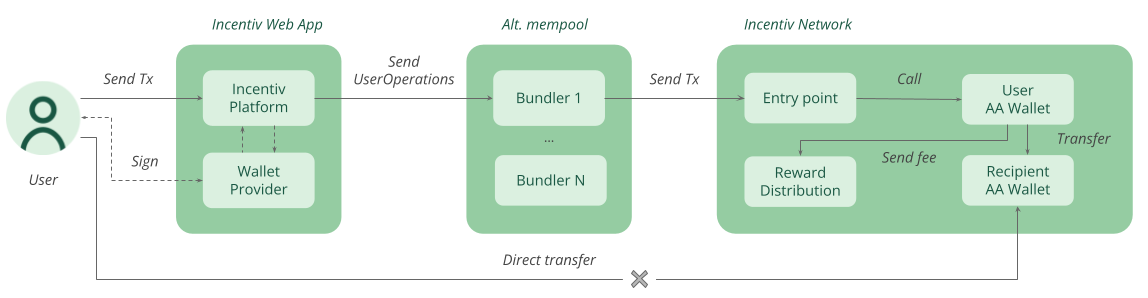
Interacting Through Intent
Smart wallets shift blockchain interaction from low-level mechanics to clear intent. When users perform an action — sending assets, swapping tokens, or automating a process — they describe what they want to happen. The wallet determines how to perform it safely and consistently.
The user does not need to consider gas tokens, signatures, or internal transaction formatting. Those details are handled by the wallet’s logic, resulting in an experience that feels modern and intuitive while remaining entirely self-custodial.
Built for Modern User Needs
Because smart wallets are programmable, they support capabilities that reflect real-world expectations: recoverable access, flexible authentication methods, temporary permissions, and application-sponsored fees. These are not added features but natural consequences of allowing the wallet to define its own verification logic.
The result is a system that feels both safer and more capable than the traditional single-key approach.