

What a Paymaster Actually Does
A paymaster steps in during a UserOperation to guarantee that the network will be paid for executing it. The user can submit an action using any supported token, or even without holding tokens at all. The paymaster evaluates the request, checks its own policies, and decides whether to sponsor the fees. If it approves, the operation moves forward exactly as if the user had provided gas themselves. This creates a flexible model where apps can handle fees for their users, where wallets can route payments intelligently, and where users are no longer blocked by not holding the “right” token.Paymasters are Important
The presence of a paymaster makes the network dramatically easier to use. New users can sign up and interact with an application without first acquiring the native token. Existing users can choose whichever asset they prefer for fees. Applications can design experiences where costs are absorbed for onboarding, growth, or specific actions. This flexibility improves both usability and developer control. Instead of working around gas requirements, builders can design experiences where fees are predictable, invisible, or optimized for the user’s state and device.How Paymasters Ensure Safety
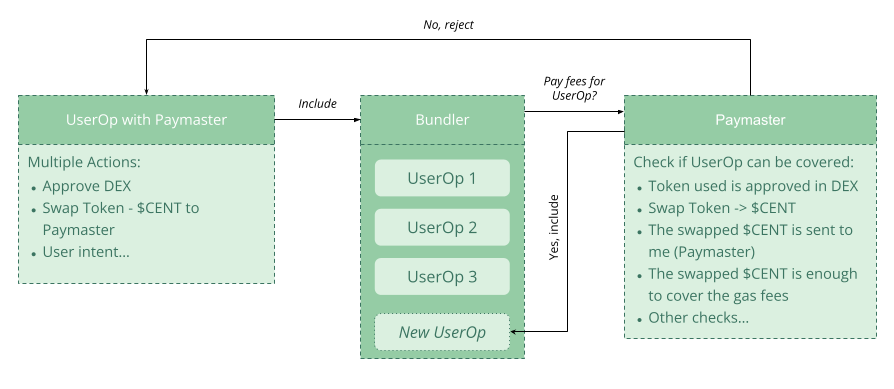
Real-World Examples
- A DeFi app might cover the first few transactions for a new user to reduce onboarding friction.
- A game could allow micro-transactions without requiring the user to manage gas at all.
- A wallet may route payments through a preferred stablecoin instead of relying on the native token.