

From User Intent to Execution
Execution begins at the wallet level. Instead of crafting a raw transaction, the wallet compiles a UserOperation that describes the user’s intent. This operation may include multiple actions, custom validation rules, gas abstraction logic, or sponsorship conditions. The wallet does not send this operation directly to the chain. Instead, it broadcasts it to a specialized mempool designed for UserOperations.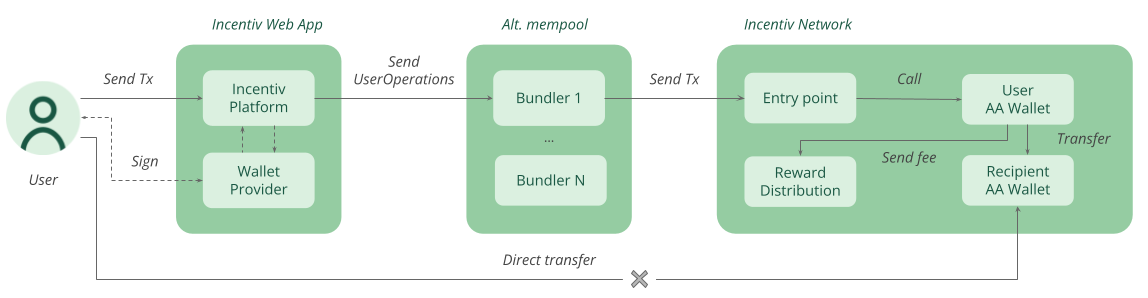
Bundlers and Submission
Bundlers monitor the UserOperation mempool. They simulate operations off-chain to ensure they are valid, executable, and economically covered. Once validated, a bundler packages one or more UserOperations into a transaction and submits it to the network. At this point, the flow converges with standard blockchain execution: the bundled transaction is included in a block and processed by all nodes.EntryPoint Validation
Inside the EVM, execution begins at the EntryPoint contract. The EntryPoint is responsible for validating each UserOperation before execution. This includes checking wallet logic, signatures, nonces, and Paymaster conditions if gas is being sponsored. Only operations that pass validation proceed to execution. Invalid operations are rejected without affecting global state.EVM Execution
Once validated, the operation is executed inside the EVM using identical opcodes, gas rules, and semantics as Ethereum. Contract calls, state changes, storage writes, and reverts all behave exactly as they would in a standard EVM transaction. Gas usage is measured deterministically during execution, ensuring predictable outcomes across all nodes.Finalizing State and Fees
After execution completes, internal protocol pathways finalize the result. Gas costs are settled using the unified fee model, potentially involving Paymasters and deterministic swaps via the native DEX. Balances, protocol accounting, and reward flows are updated accordingly. The final state transition is then committed to the blockchain, identical on every node.In Summary
- Wallets express intent.
- Bundlers package and submit it.
- The EntryPoint validates it.
- The EVM executes it.
- The protocol finalizes state and fees.