

Incentiv takes a familiar model, Proof-of-Work, and adapts it to a zero-inflation reward model. Unlike traditional PoW systems that pay miners through fixed inflationary block subsidies, Incentiv has zero block rewards from genesis. Miners are rewarded from gas fees only: 12.5% of gas fees per block go to miners, while the remaining 87.5% flows to the on-chain FeeDistributor.
Why We Chose Proof-of-Work
Proof-of-Work remains the only consensus mechanism that is truly open to anyone. No staking requirements. No minimum token balance. No validator cartels.Just a GPU, electricity, and the willingness to contribute. PoW offers something uniquely powerful: Neutrality — Security rooted in physics, not wealth.
Accessibility — Anyone can mine; no capital gatekeeping.
Predictability — Deterministic validation and simple rules.
Global decentralization — Broad participation without permission. Incentiv chooses PoW not because it is old, but because it is the fairest and most inclusive way to secure an open network.
But we also recognize its flaws — so we fixed them.
The Problem with Traditional PoW
Classic PoW was not designed for modern economies.Its security budget is fixed, regardless of whether the network is empty or booming. During quiet periods it wastes energy; during peak usage it doesn’t increase security where it is most needed. Inflationary block rewards distort the token economy.
Miners earn the same amount whether the chain is providing value or not. Token holders are diluted continuously. The system has no responsiveness, no self-correction, and no relation to actual demand. In short: traditional PoW is static in a world that demands adaptability.
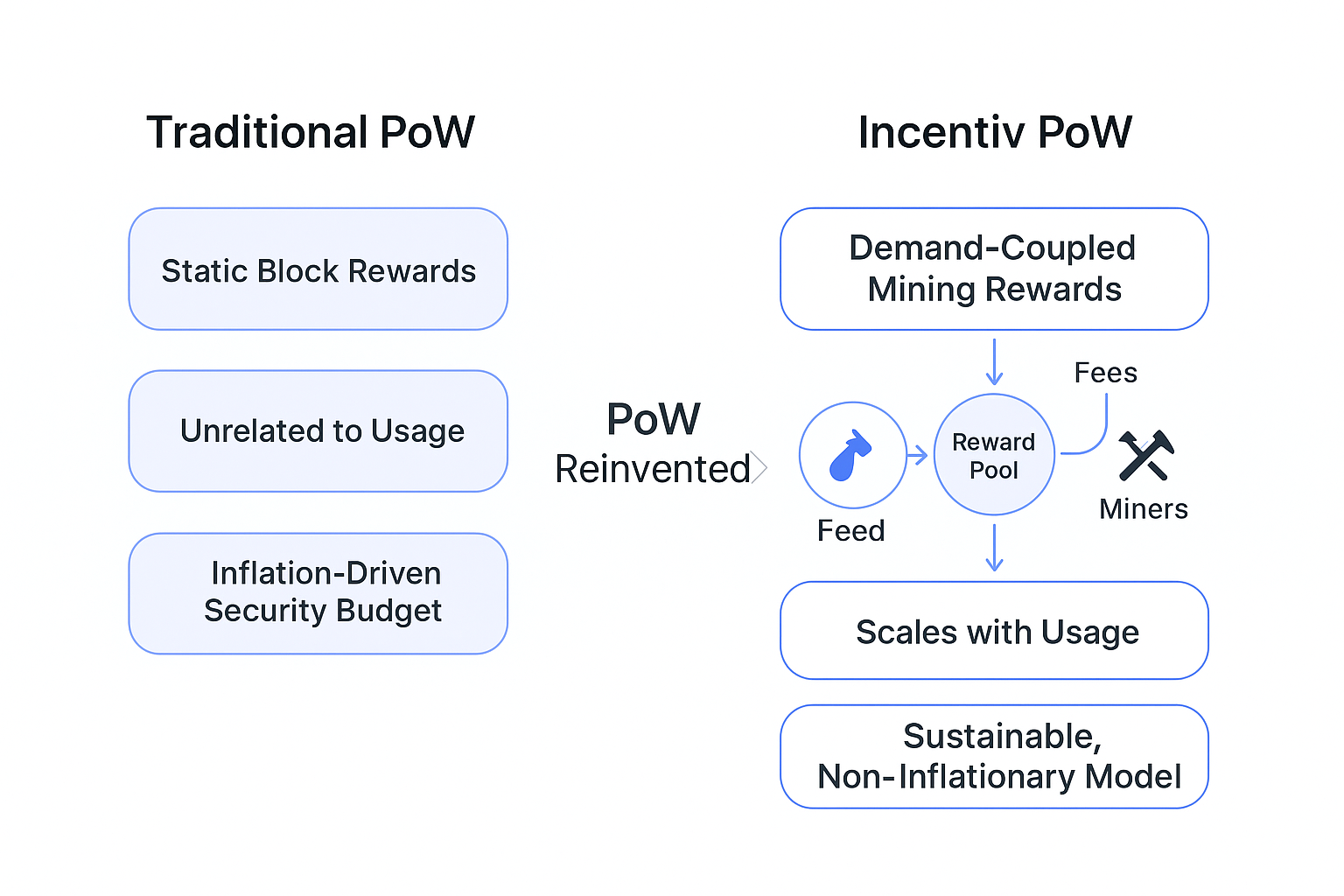
Our Solution: Zero-Inflation Proof-of-Work
Incentiv removes inflationary block subsidies entirely. Miner rewards come from real network usage through gas fees. As activity increases, total fee revenue can naturally increase as well, but the protocol split is fixed:- 12.5% of gas fees go to miners
- 87.5% of gas fees flow to the on-chain FeeDistributor
Mining Designed for Humans
Incentiv uses an enhanced Ethash design — memory-hard, accessible, and GPU-friendly.This ensures mining remains decentralized and widely available. No closed validator sets, no hardware oligopolies. Anyone who contributes compute strengthens the shared infrastructure. This is how Incentiv maintains decentralization without sacrificing performance or inclusivity. Ethash Memory-Hard Mining
- GPU-friendly
- ASIC-resistant
- Secure and permissionless
- Keeps mining competitive instead of centralized
How It Works
Here’s how Incentiv’s consensus system operates end-to-end:- Miners compute Ethash proofs
GPUs perform memory-hard hashing to propose the next block. - Transactions enter block candidates
UserOperations and regular transactions are processed through the EVM, following Ethereum semantics. - Gas fees are collected per block Each block collects gas fees from executed transactions.
- Fees are split by a fixed protocol ratio Miners receive 12.5% of gas fees, while 87.5% flows to the on-chain FeeDistributor.
- Nodes validate and execute the block
Every node re-executes the EVM computation to confirm the correctness of the state transition. - Fork choice selects the chain with the most cumulative work
The longest-work chain is accepted, ensuring objectivity and resistance to manipulation. - Miners receive the miner fee share Miners earn the fixed 12.5% share of gas fees from the blocks they produce.
A Consensus Layer aligned with Contribution
By removing inflationary block rewards and routing gas fees through a fixed protocol split, Incentiv turns Proof-of-Work into a fee-based security model. Miners secure the network and receive 12.5% of gas fees, while the remaining 87.5% supports the broader on-chain FeeDistributor system.This ensures sustainability, fairness, and long-term decentralization across the entire network.