

How the Economic Engine Works
Every transaction on Incentiv pays gas fees. These fees split at the protocol level: a portion goes directly to miners as immediate block rewards, and the remainder enters a unified reward pool distributed weekly to all contributor roles. The pool recognizes five distinct stakeholder types: miners, developers, users, liquidity providers, and bundlers. Each role is scored independently on metrics specific to their contribution type. At the end of each epoch, rewards are distributed proportionally based on these scores. Because scoring resets weekly and uses multiple metrics per role, no single actor can accumulate permanent advantage. New participants can compete immediately, and consistent contribution matters more than early positioning.Why This Model Exists
Traditional blockchain economics create extraction dynamics. Miners extract from users. Protocols extract from traders. Platforms extract from developers. One party’s gain becomes another’s loss. Incentiv+ inverts this relationship. Fees are not extraction — they are contribution to a shared pool that flows back to those who generate network value. A developer whose contracts process high volume isn’t just paying gas; they’re earning a share of the developer pool. A user who transacts frequently isn’t just spending fees; they’re accumulating score toward user rewards. This alignment means that when the network succeeds, all contributor types succeed proportionally. There are no adversarial dynamics between roles.The Five Stakeholder Roles
The unified reward pool divides among five roles, each essential to network function: Miners secure the chain through Proof-of-Work block production. They receive both immediate block rewards and weekly participation rewards based on uptime and network contribution. Developers build applications that give users reasons to transact. Their rewards scale with the usage their contracts generate — volume processed, transactions handled, and unique wallets served. Users drive the fundamental demand signal through transaction activity. Active users who transact frequently across multiple applications earn back a portion of their fees. Liquidity Providers supply capital to DEXes and lending protocols, enabling the DeFi functionality that drives transaction volume. Their rewards reflect depth, duration, and utilization of provided liquidity. Bundlers aggregate Account Abstraction user operations and ensure efficient inclusion. Their rewards reflect operational volume, gas efficiency, and reliability. Each role competes only within itself. Developers don’t compete with miners for rewards; each has a dedicated allocation. This prevents any single role from cannibalizing another while ensuring all roles benefit from overall network growth.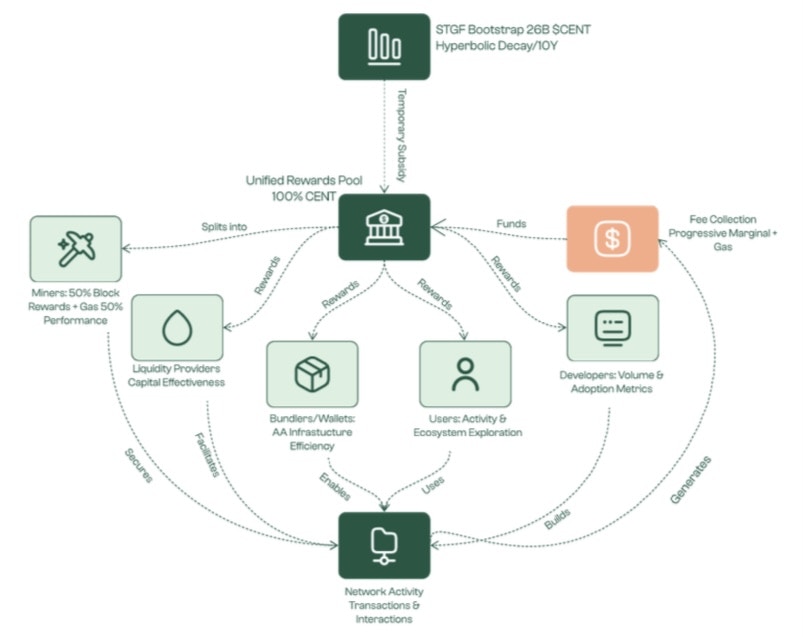
Incentiv+ as Part of the Protocol Architecture
Because the economic engine integrates at the protocol level:- Fee splitting happens automatically on every transaction
- Scoring uses on-chain data, making calculations transparent and verifiable
- Distribution occurs through smart contracts without manual intervention
- Parameters are governance-adjustable as the ecosystem matures
Fee Mechanism Incentiv uses a gas-based fee model where every transaction pays for the computational resources it consumes. Unlike networks that treat fees purely as miner compensation or burn mechanisms, Incentiv splits fees between immediate block rewards and a unified pool that flows back to all network contributors. This approach ensures that paying fees is not just a cost — it is participation in the network’s economic engine.
How Fees Are Calculated
Transaction fees follow standard EVM gas mechanics:How Fees Split
All transaction fees divide at the protocol level into two streams: Miner Block Rewards (12.5%) flow immediately to the block producer. This ensures miners receive direct compensation for the security-critical function of block production without waiting for epoch boundaries. Unified Reward Pool (87.5%) accumulates throughout the epoch and distributes weekly to all contributor roles based on their measured contribution scores. This split happens automatically on every transaction. There is no opt-in, no configuration, no special transaction type. The economic engine processes every fee according to the same logic.Why Gas-Based Rather Than Value-Based
Early Incentiv designs explored value-based fees — progressive brackets applied to transaction value, similar to tax brackets. The logic was appealing: larger economic transfers would contribute proportionally more to the reward pool. Implementation revealed practical challenges. Calculating marginal rates added computational overhead. Determining transaction “value” for batched operations, contract calls, and AA user operations required complex classification logic. Price oracle dependencies introduced latency and manipulation surface at the consensus layer. Gas-based fees achieve the same economic goals with cleaner execution. High-complexity operations that consume more resources pay more. The circular economy functions identically. The allocation percentages remain unchanged. What changed is the input mechanism — and that change simplified implementation while aligning with established EVM patterns. The value-based model remains a governance-addressable evolution path if future conditions warrant it.Fee Flow Through the System
When a user submits an operation:- The transaction executes and consumes gas
- The fee calculates as gas used multiplied by gas price
- 12.5% transfers immediately to the block producer’s coinbase address
- 87.5% credits to the unified reward pool contract
- At epoch end, the pool distributes to all roles based on contribution scores
Current Network Parameters
| Parameter | Value |
|---|---|
| Target base fee (simple transfer) | ~$0.03 USD |
| Average gas per user operation | ~550,000 units |
| Current gas price | ~40,000 gwei |
| Block reward share | 12.5% |
| Unified pool share | 87.5% |